
Biofuels
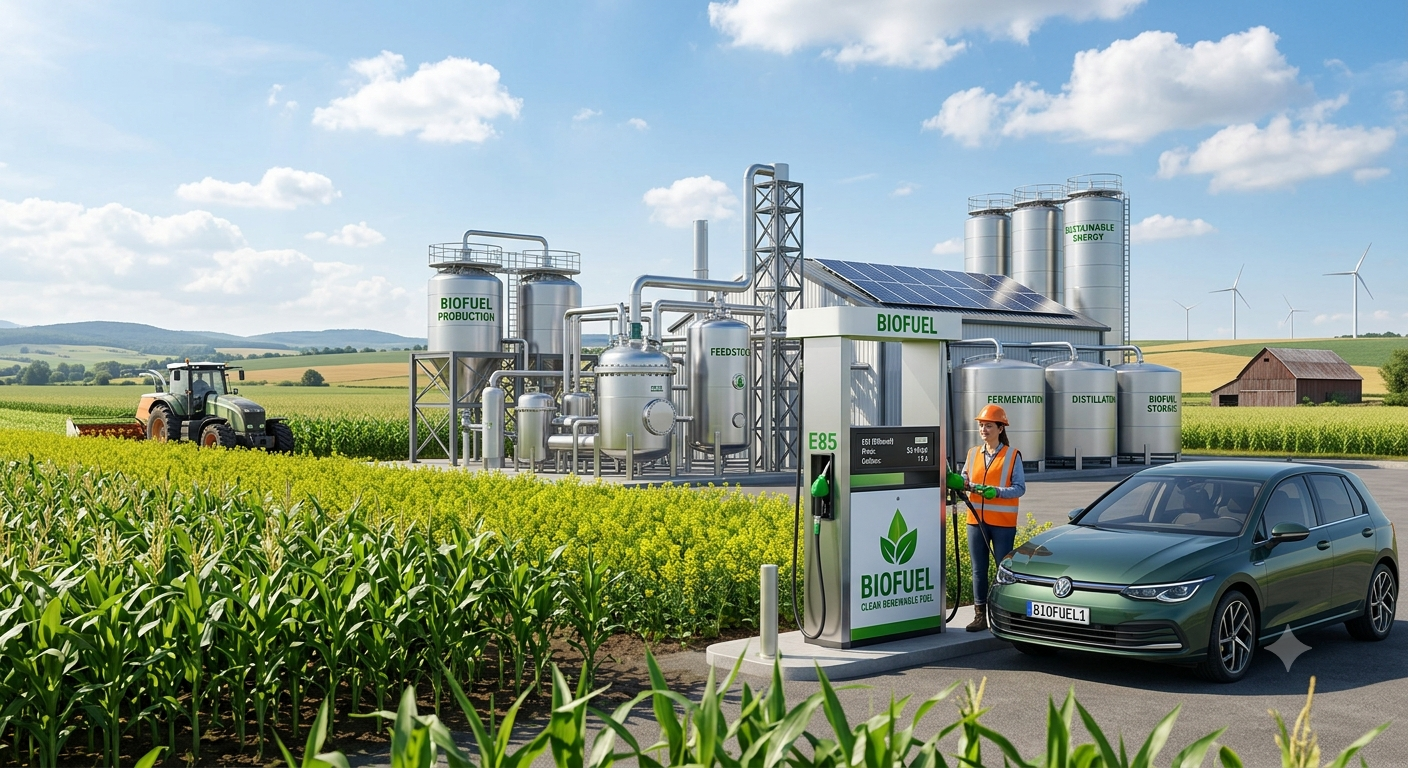
The global biofuel sector is experiencing rapid scaling driven by regulatory mandates, energy security imperatives, and decarbonization targets across heavy transport, aviation, and maritime industries. Global market capacity is transitioning dynamically into high-blend drop-in infrastructures.
Market Valuation
Global Biofuel Market:
Current Market Valuation (2026): $170-185 Billion
Long-Term Valuation (2032): Projected $260-$285 Billion
Compound Annual Growth Rate (CAGR): 6.5-7.2%
United States Biofuel Market:
Current Market Valuation (2026): $45-52 Billion
Long-Term Valuation (2032): Projected $70-78 Billion
Compound Annual Growth Rate (CAGR): 6.20-6.80%
Market Share and Segments
The global composition of biofuels remains anchored by conventional ethanol, though advanced "drop-in" hydrocarbons (Renewable Diesel and Sustainable Aviation Fuel) represent the fastest-growing market capitalization shares:
Fuel Ethanol (~62% Global Share): Dominates total volume, driven predominantly by dry-mill corn processing in North America and sugarcane crushing in South America.
Biodiesel & Renewable Diesel (~34% Global Share): Renewable diesel (HVO) is steadily capturing market share from traditional FAME biodiesel due to its seamless infrastructure compatibility and superior cold-flow properties.
Sustainable Aviation Fuel (SAF) (~4% Global Share): Experiencing exponential multi-year growth curves, heavily incentivized by corporate scope 3 emission reductions and international mandates.
United States Strategic Position
The strategic framework of the United States centers on domestic energy dominance, supporting the rural agricultural economy, and safeguarding domestic industries from foreign trade imbalances.
Domestic Volume Expansion (RFS "Set 2" Rule): The EPA's finalized volume requirements enforce historically high blending mandates. This structural policy injects over $10 billion into rural domestic economies while effectively displacing roughly 300,000 barrels of foreign crude oil imports per day.
Accelerating Advanced Hydrocarbons: Federal strategy prioritizes scaling advanced drop-in fuels. Biomass-based diesel production requirements are mandated to scale over 60% to meet new volume baselines. Simultaneously, Sustainable Aviation Fuel (SAF) remains a high-priority vehicle for maintaining clean energy innovation dominance.
Regulatory & Commercial De-bottlenecking: The US is actively removing infrastructure hurdles by standardizing year-round retail access to higher ethanol blends like E15 and simplifying commercial logistics for fuel blenders.
Long-Term Fiscal Predictability: Transitioning toward carbon-intensity-indexed structures like the 45Z Clean Fuel Production Credit provides long-term certainty to agricultural processors, linking farming practices directly to corporate tax incentives via rigorous lifecycle accounting models.