
Rare Earth Elements and Critical Minerals
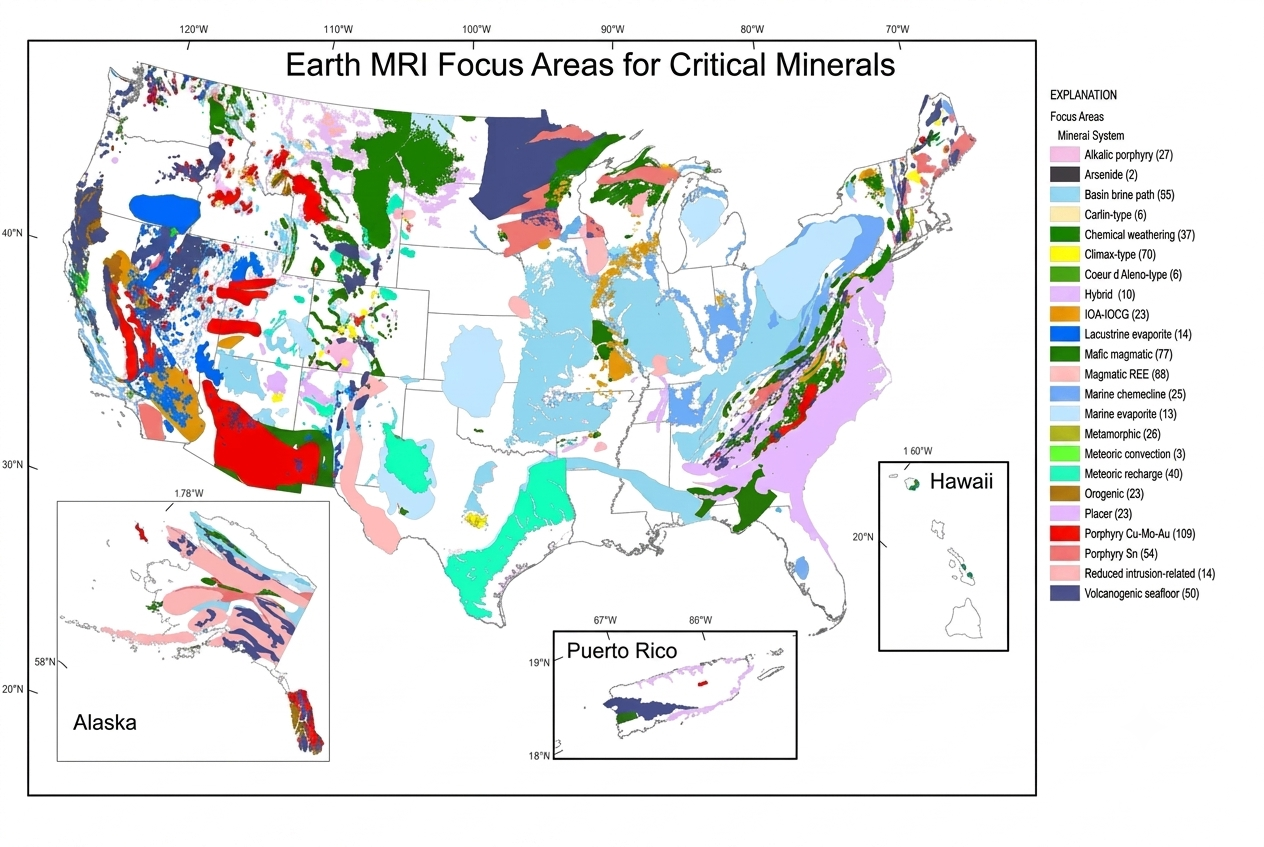
U.S.G.S. Critical Minerals Map
Rare Earth Elements (REEs) and Critical Minerals are an important component of modern technology, national defense, and manufacturing.
Ned Mamula, USGS Director stated the importance of making these minerals a priority for development and production within the United States.
“Critical minerals underpin industries worth trillions of dollars, and import dependence puts key sectors at risk. This work helps secure the materials needed for U.S. economic growth and technological leadership.”
For the United States, these materials represent a major strategic vulnerability and massive investment programs are in place and developing to address this vital need.
PetroSun’s research and development efforts have focused on a number of these rare earth elements and critical minerals.
Geopolitical Supply Chain Challenge
The core significance of these minerals for the US isn't just what they do, but where they come from.
Historically, the US has relied heavily on foreign nations—most notably China—for both the raw mining and, more importantly, the highly complex chemical refining of these materials. For instance, China controls roughly 99% of the world's gallium refining and a massive majority of other rare earth processing.
Because export controls or geopolitical trade disputes could easily paralyze key American manufacturing sectors, securing the supply chain has become a matter of economic survival.
Current US Strategy
To mitigate this risk, the US government and private sectors are actively deploying a multi-billion dollar domestic strategy focused on:
Ramping Up Domestic Production: Funding initiatives (like the Department of Defense's Industrial Base Fund) to build local refining facilities that process raw materials right here in the US.
Resource Diplomacy: Bundling defense agreements and forming strategic partnerships with resource-rich allies like Australia, Canada, and Greenland to secure alternative supply pipelines.
Recycling and Urban Mining: Investing heavily in next-generation technologies to extract rare earths and battery metals out of recycled electronics, permanent magnets, and industrial waste tailings.
Industries Impacted
National Defense and Aerospace
Advanced military hardware is entirely dependent on the unique magnetic, optical, and structural properties of critical minerals. There are often no viable substitutes for these applications.
Permanent Magnets: REEs like neodymium and dysprosium are used to create incredibly powerful, lightweight magnets vital for missile guidance systems, radar, avionics, precision-guided munitions, and electric motors in military vehicles.
Superalloys: Minerals like cobalt, titanium, yttrium, and rhenium allow jet engines and gas turbines to withstand the extreme temperatures required for supersonic flight.
Night Vision and Optics: Lanthanum is a staple in advanced camera lenses and night-vision goggles, while germanium is essential for infrared sensors.
Energy Grid and Next GenerationTechnology
The transition toward advanced electronics and diversified energy infrastructure relies completely on these materials.
Batteries: Lithium, cobalt, nickel, manganese, and graphite are the fundamental ingredients for electric vehicles (EVs) and large-scale grid storage batteries.
Semiconductors: Modern microchips and fiber optics require highly precise inputs of obscure critical minerals like gallium, indium, and silicon.
Traditional Industry: The U.S. Geological Survey expanded its critical minerals list to include: foundational industrial elements like copper (for massive electrical grid expansions) and potash/phosphate (vital for agricultural fertilizers).