
Zeolite
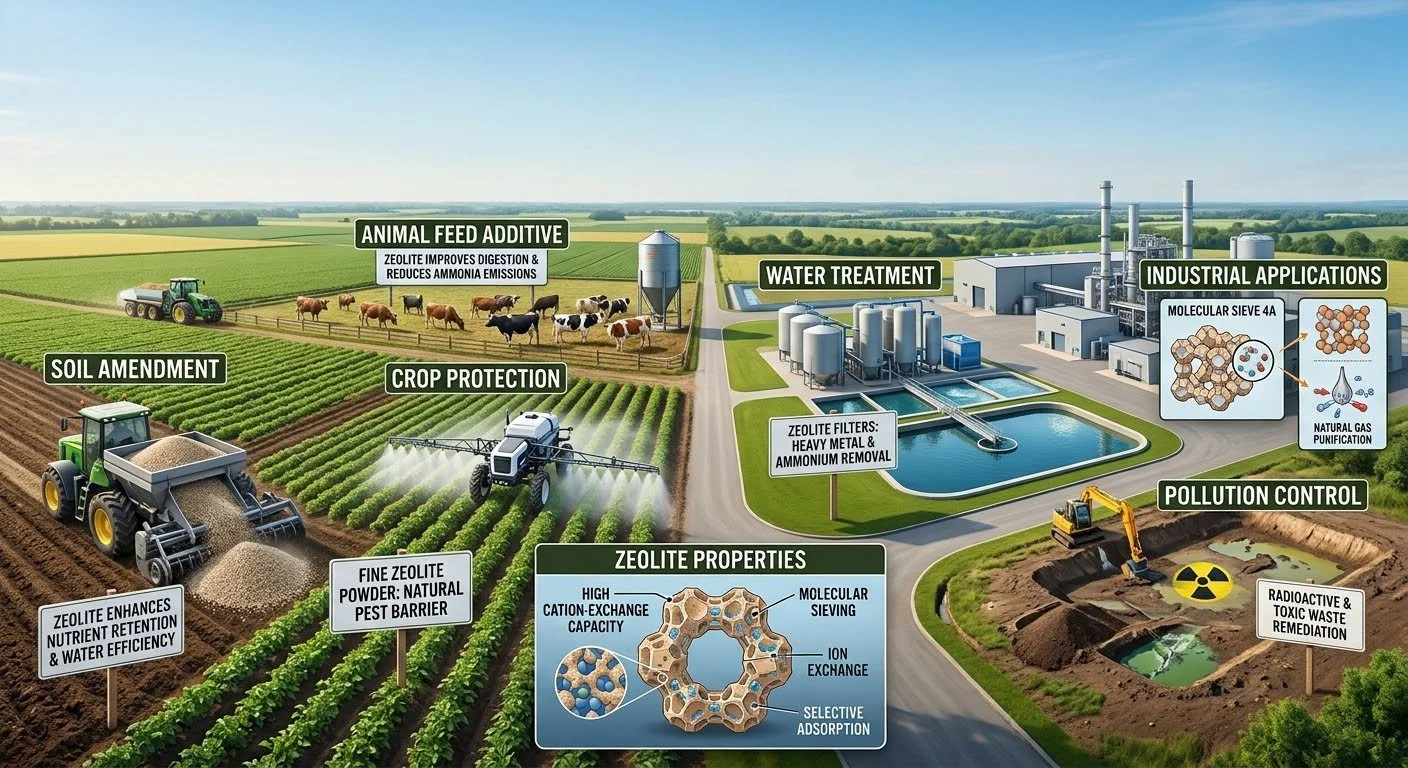
Zeolites are crystalline, microporous aluminosilicates characterized by highly organized, three-dimensional frameworks of silica and alumina tetrahedra.
Known chemically as "molecular sieves," their unique structure features uniform nano-cages and channels containing exchangeable cations. This composition grants them exceptional ion-exchange capacity, molecular shape-selectivity, and thermal stability—making them vital to modern petrochemical, agricultural, and water treatment operations.
Production of synthetic zeolites from natural zeolites is a rapidly growing area of industrial and academic-based research known as interzeolite transformation. The primary reasons include massive cost savings and exponentially higher performance due to Cation Exchange Capacity (CEC), which provides the ability to swap out and trap heavy metals and pollutants.
Market Valuation
The global zeolite landscape is split into high-volume, low-cost natural zeolites (primarily mined via open-pit operations) and high-value, highly uniform synthetic zeolites engineered for precise industrial catalysis.
Natural Zeolite, including bulk commercial mixes:
Current Market Valuation (2026): Estimated at $9.6 billion.
Long-Term Valuation (2034–2035): Projected to expand to roughly $17.4 billion.
Compound Annual Growth Rate (CAGR): Sustaining a stable 6.76% trajectory over the next decade.
Synthetic Zeolite:
Current Market Valuation (2026): Estimated at $5.68 billion.
Long-Term Valuation (2034–2035): Projected to expand to roughly $6.78 billion.
Compound Annual Growth Rate (CAGR): 2.18%.
North American Average Retail
Natural Zeolite:
Standard agricultural grade - $ 110-250 per ton
Highly refined technical grade - $ 300-950 per ton
Synthetic Zeolite:
Basic Detergent Grade - $ 200-600 per ton
Standard Absorbent and Drying Grades - $ 1,000-2,000 per ton
Specialty and Petrochemical Catalysts - $ 10,000-100,000 per ton
Production
Natural Zeolite Production:
Global production is diverse with over 65% of global production is in these 6 countries. According to the USGS annual worldwide production is approximately 1.3 million metric tons.
Slovakia 21.5%
South Korea 12.3%
China 11.5%
Indonesia 9.2%
New Zealand 7.7%
United States 6.2%
Synthetic Zeolite Production:
Synthetic zeolites are manufactured in chemical synthesis plants aligned with chemical refining markets.
Asia-Pacific: 33.4 to 41.0%
China dominates this group due to “China 6” fuel refining standards and massive detergent manufacturing. Includes China's extensive domestic chemical manufacturing sector and widespread use of natural zeolites in localized agricultural grids. The region is also pioneering green synthesis methods, such as co-recycling industrial slag and rice husk ash into high-purity crystalline zeolites.
North America: 19.0 to 26.0%
The United States holds 85% of this group which is heavily focused on optimizing fluid catalytic cracking catalysts to supply Gulf Coast oil refineries. Applications also include ultra-pure gas separation, heavy metal water filtration, and zero-emission vehicle catalytic converters.
Europe: 20.0 to 22.0%
Green building materials, premium specialty absorbents, and “Euro 7” emissions compliant automotive catalysts.
Latin America: 4.0 to 5.0%
Led by Brazil producing catalysts for ethanol and biofuels.
Industrial and Agricultural Applications
The consumption of zeolites is deeply tied to their specific chemical frameworks, dividing their market presence across distinct value tiers.
Petrochemical Catalysis (High Value): Synthetic Zeolite Y (FAU framework) and ZSM-5 (MFI framework) serve as the bedrock of Fluid Catalytic Cracking (FCC) units in petroleum refining. They crack heavy crude oil fractions into gasoline and lighter fuels, favored for their hydrothermal stability and shape-selectivity.
Detergent Builders (High Volume Baseline): Synthetic Zeolite A (LTA framework) is mass-produced as an eco-friendly replacement for environmental-hazardous phosphates. It functions as a water softener by exchanging its internal sodium ions for calcium and magnesium ions present in hard wash water.
Agriculture & Soil Remediation: Bulk natural zeolites—principally clinoptilolite—are mixed into fertilizers to enable slow-release nutrient delivery, which minimizes nitrogen leaching into water tables. They are also heavily utilized in livestock feed to bind dangerous mycotoxins and trap ammonia.
Lithium & Green Technology: Emerging high-growth submarkets are utilizing specialized synthetic zeolites as selective adsorbents for next-generation, water-efficient lithium extraction from geothermal fluids and brines.