
Potash
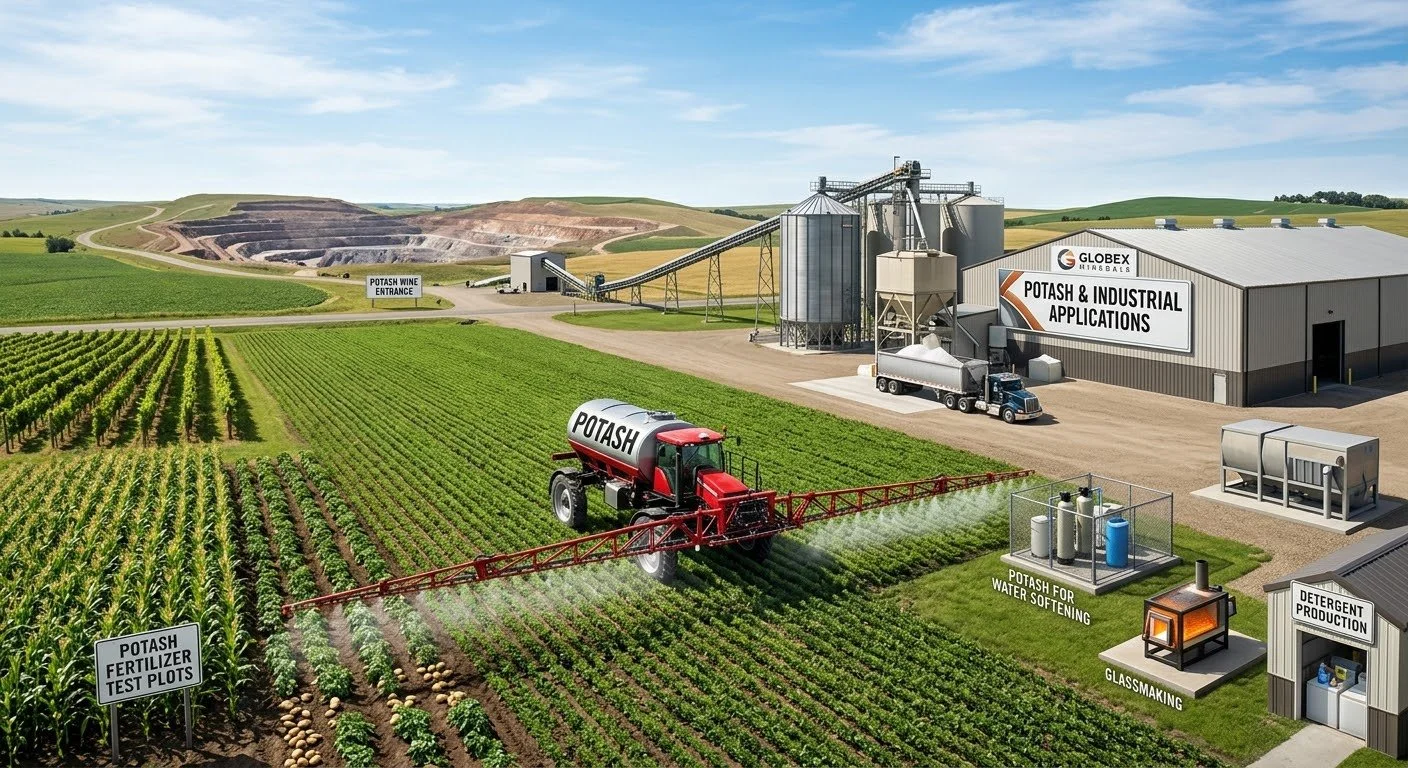
The U.S. relies on foreign trade for 92% to 95% of its essential potash.
Market Valuation
The global potash market is expanding steadily, driven by shrinking arable land per capita, rising populations, and the critical need to enhance global crop yields.
Current Market Valuation (2026): Estimated between $68.68 billion and $70.15 billion.
Long-Term Valuation (2034–2035): Projected to expand to roughly $106.09 billion to $106.76 billion.
Compound Annual Growth Rate (CAGR): Sustaining a stable 4.84% to 5.39% trajectory over the next decade.
Capacity Forecast (2029): The U.S. Geological Survey (USGS) projects global capacity to hit 77.4 million metric tons by 2029, spurred by major mine expansions across Canada, Russia, Belarus, Laos, and Brazil.
Global commodity pricing has settled considerably compared to the historical geopolitical price spikes seen in 2022.:
North American Average Retail: ~$494 per ton
United States f.o.b. Mine Price: $1,200 per metric ton
China: ~$374/MT | Germany: ~$366/MT | Indonesia: ~$393/MT
The $1,200 U.S. mine price is due to product composition. U.S. mining companies focus almost exclusively on premium, high-margin, low-chloride specialty varieties rather than basic bulk field run.
Production
Potash Production is geographically highly consolidated due to the rare distribution of massive, extractable evaporite salt deposits. Four countries dominate the market:
Canada (15.0 million MT): Controls 32.4% of global capacity. Operations are led by Nutrien and Mosaic, including Mosaic's Esterhazy K3 site, the world’s largest potash mine.
Russia (~12.5 million MT): Controls 18.6% of capacity. Production continues to scale through vast new mining projects in Siberia.
Belarus (~10.0 million MT): Controls 14.9% of capacity. Supply volumes have largely rebounded as export corridors adapted around historical trade restrictions.
China (~6.2 million MT): Controls 9.3% of capacity. The majority of Chinese extraction is retained domestically to ensure localized food security.
United States Strategic Position
The United States maintains a complex, high-risk position in the global landscape, characterized by acute import dependence paired with aggressive new industrial policy to secure domestic supply.
The Domestic Deficit: The U.S. agricultural grid consumes 5.9 million metric tons of potash annually, yet domestic operations yield only about 500,000 metric tons.
92% Net Import Reliance: The U.S. relies on foreign trade for 92% to 95% of its essential potash.
The Import Pipeline: The U.S. relies on three primary trade partners to bridge this gap: Canada (79%), Russia (12%), and Israel (3%).
Acknowledging the threat a fertilizer cutoff poses to domestic food infrastructure, the U.S. government officially reinstated potash to the federal Critical Minerals List, triggering streamlined environmental permitting and targeted capital access.
Industrial & Agricultural Applications
Potash primarily functions to supply potassium, one of the three foundational macronutrients underpinning commercial agriculture alongside Nitrogen and Phosphorus.
Agricultural Sector(93%–94% of Global Use)
Muriate of Potash (MOP): Commands 53% to 54% of total global volume. High in chloride, it is highly soluble and functions as the default fertilizer for high-acreage, hardy staple crops like corn, wheat, soybeans, and rice.
Sulfate of Potash (SOP) & Specialty Blends: SOP and Potassium Magnesium Sulfate (SOPM/Langbeinite) represent premium, chloride-free formulations.
The U.S. Production Inversion: While the world uses MOP by default, over 60% of all potash extracted within the U.S. is premium SOP/SOPM. This caters directly to high-value, chloride-sensitive cash crops (like tree nuts, citrus fruits, and specific vegetables) central to North American agricultural revenue.
Industrial & Technical Applications (6%–7% of Global Use)
Chemical Precursors: Processed into potassium hydroxide (KOH) and potassium carbonate to formulate industrial soaps, detergents, glass, and textiles.