
Graphite
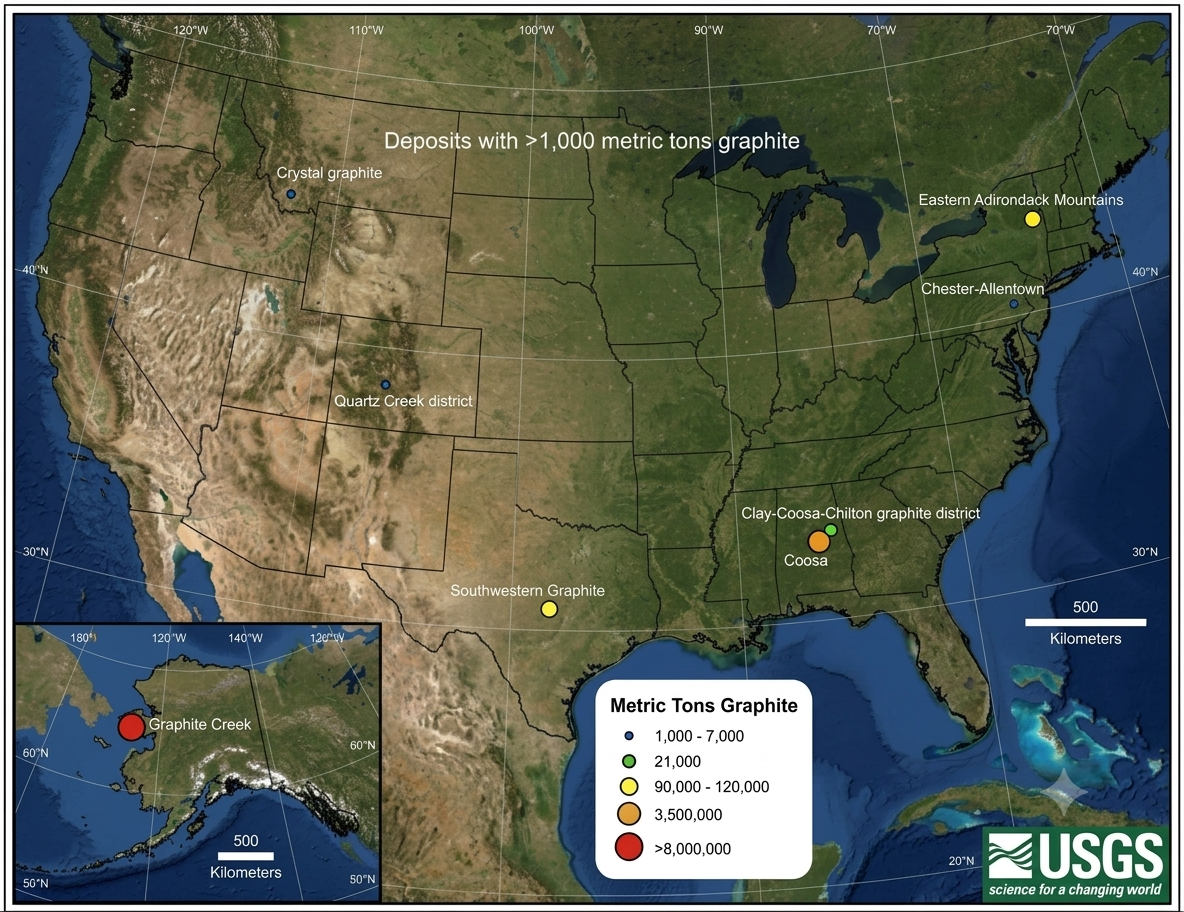
USGS Image
Graphene, a nano-engineered derivative, and its parent material, Graphite, serve as foundational cornerstones for today's advanced materials sector. In industry, natural graphite is primarily found in three formats: flake, crystalline vein (lump), and amorphous. On the other hand, synthetic graphite is produced by processing petroleum coke or coal tar pitch under high-temperature graphitization, delivering exceptional structural consistency and high purity.
Graphene consists of a single atomic layer of carbon structured in a two-dimensional honeycomb lattice. It features remarkable physical traits, including a tensile strength of σ = 130 GPa, thermal conductivity scaling up to K = 5,000 W/m·K, and an inherent electron mobility of μ = 200,000cm²/V·s.
Market Valuation
Global Craphite Market (Natural and Synthetic):
Current Market Valuation (2025): $24.8 Billion
Long-Term Valuation (2032): Projected $43.2 Billion
Compound Annual Growth Rate (CAGR): 8.2%
United States Graphite Market:
Current Market Valuation (2025): $1.9 Billion
Long-Term Valuation (2032-2033): Projected $3.5 Billion
Compound Annual Growth Rate (CAGR): 9.1%
Global Graphene (Powders and Sheets):
Current Market Valuation (2025): $450 Million
Long-Term Valuation (2032-2033): Projected $3.8 Billion
Compound Annual Growth Rate (CAGR): 30.5%
United States Graphene:
Current Market Valuation (2025): $135 Million
Long-Term Valuation (2032-2033): Projected $960 Million
Compound Annual Growth Rate (CAGR): 28.2%
United States Strategic Position
The U.S. Geological Survey (USGS) and the United States Department of the Interior formally list graphite as a mineral crucial to domestic economic stability and national security. As of 2026, the U.S. remains virtually 100% dependent on imports for natural flake graphite, exposing domestic production to a high risk of overseas supply chain disruptions.
The geopolitical risk profile surrounding graphite is highly concentrated. China commands more than 70% of the world's natural graphite mining output and over 90% of the downstream purification facilities needed to create spherical graphite for battery anodes. Tight export limitations instituted by China regarding graphite materials have increased supply threats for American commercial and military supply networks. Similarly, the production of synthetic graphite faces limitations due to the availability of specialized needle coke, a material vulnerable to environmental regulation modifications and power grid disruptions.
Graphite represents a major vulnerability for defense logistics, as it is indispensable for building stealth aircraft structural airframes, nose cones for hypersonic re-entry vehicles, and nozzle liners inside solid rocket motor boosters. To address this, the U.S. Department of Defense has distributed Defense Production Act (DPA) Title III funding to fast-track regional synthetic graphitization processing and secure regional logistics channels. Additionally, the Inflation Reduction Act (IRA) encourages local sourcing by disqualifying electric vehicles that use critical minerals linked to a "Foreign Entity of Concern" (FEOC) from receiving federal tax incentives, driving immediate capital investments into synthetic fabrication infrastructure and North American mining ventures.
Industrial Applications
Graphite Applications
The industrial utilization of graphite is split into traditional heavy metallurgical applications and advanced energy storage systems:
Battery Anodes: The single largest growth sector for graphite is the manufacturing of the active anode material in lithium-ion batteries. Every lithium-ion battery requires roughly 10 to 15 times more graphite by weight than lithium. Spherical graphite, derived from natural flake graphite via intensive shaping and purification, or synthetic graphite blends, forms the intercalation matrix for lithium ions.
Metallurgy and Refractories: Due to its high melting point (T >3,500°C) and thermal shock resistance, graphite is vital for crucibles, ladles, and bricks lining electric arc furnaces (EAF) used in steel production. Synthetic graphite electrodes are indispensable for high-temperature smelting.
Lubricants and Recarburizers: Fine powders are utilized as dry lubricants in high-friction environments and as carbon additives to adjust carbon ratios in foundry steel melt processing.
Graphene Applications
Graphene is employed as a performance additive to dramatically alter the physical properties of host materials:
Advanced Electronics & Semiconductors: Graphene's high electron mobility renders it a prime candidate for next-generation radiofrequency transistors, optoelectronic photodetectors, and thermal dissipation films in high-performance microchips.
Structural Composites: Infusing carbon-fiber reinforced polymers (CFRP) or concrete with graphene nanoplatelets (GNPs) increases tensile strength, minimizes micro-cracking, and imparts electrical conductivity to structural surfaces.
Energy Storage: Graphene coatings on lithium-sulfur or silicon-anode battery architectures decrease internal resistance, enhance charge-transfer kinetics, and extend cycle lifespan.