
Hydrogen
The global hydrogen market is undergoing a structural transition from a commodity chemical input to a cornerstone of the deep-decarbonization energy sector.
Regionally, the Asia-Pacific territory dominates global demand, accounting for 31.4% ($117.3 billion expected in 2026), driven by aggressive industrial mandates in China and import strategies in Japan. However, the market remains heavily stratified by "colors" or production modalities. Grey Hydrogen (produced via Steam Methane Reforming without carbon capture) still commands over 72% to 95% of the volume and revenue share due to its historical infrastructure and low base-cost, while Green Hydrogen is the fastest-expanding energy sector globally, growing at a meteoric CAGR of 31.2% to reach an estimated $188.9 billion by 2035.
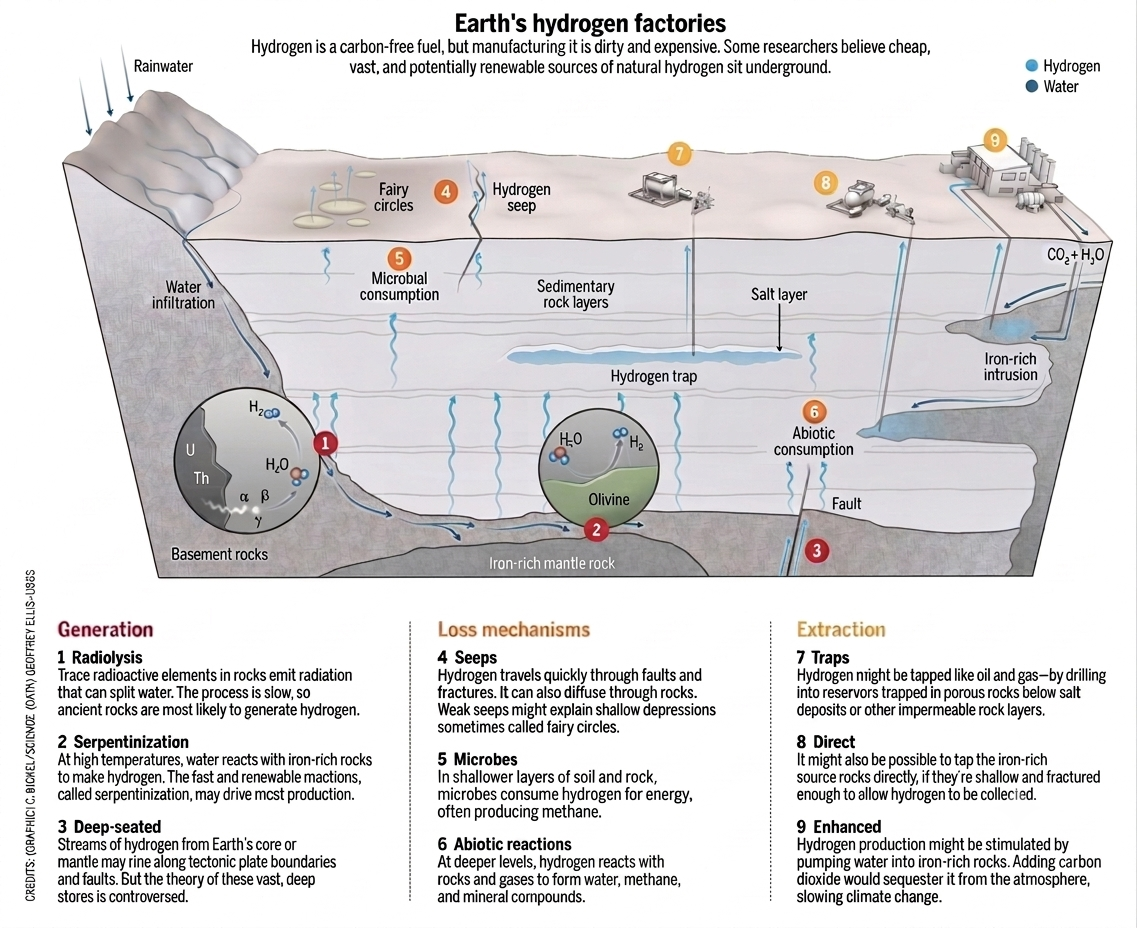
Research and development currently focuses addressing the cost of clean hydrogen through next-generation electrolyzers, liquid organic hydrogen carriers, retrofitting carbon capture, and natural hydrogen exploration.
U.S.G.S Image
Market Valuation
Global Hydrogen Market:
Current Market Valuation (2026): $225.0-$242.6 Billion
Long-Term Valuation (2033–2034): Projected to expand to roughly $401.3-$406.9 Billion
Compound Annual Growth Rate (CAGR): 6.68% - 8.60%.
United States Hydrogen Market:
Current Market Valuation (2026): $36.1-$36.58 Billion
Long-Term Valuation (2033–2034): Projected to expand to $44.16 Billion
Compound Annual Growth Rate (CAGR): 3.84%
Global Green Hydrogen Market:
Current Market Valuation (2026): $16.40 Billion
Long-Term Valuation (2035): Projected to expand to roughly $188.90 Billion.
Compound Annual Growth Rate (CAGR): 31.20%.
While overall domestic market volume grows due to established industrial refinery baselines, the sub-segments are shifting radically. Driven by Federal incentives, US Green Hydrogen capacity is scaling at a 32.9% CAGR through 2035, while water electrolysis technology scales at 29.5% annually.
United States Strategic Position
Hydrogen has ascended to a tier of vital national security and economic interest for the United States:
Geopolitical and Energy Independence
By transitioning key industrial processes to hydrogen, the United States insulates its domestic supply chains from foreign oil and gas volatility. The Federal Government has established seven regional Clean Hydrogen Hubs (H2Hubs) backed by $7 billion from the Bipartisan Infrastructure Law, creating decentralized regional energy ecosystems that ensure localized production resilience.
Decarbonizing "Hard-to-Abate" Sectors
While battery electrification can cleanly power passenger vehicles, it cannot provide the extreme energy densities required for heavy manufacturing, aviation, maritime shipping, or high-heat steel processing. Hydrogen represents the only technologically viable pathway for the US to hit its legally targeted net-zero mandates without compromising heavy industrial output.
Fiscal and Industrial Competitiveness
Under Section 45V of the Inflation Reduction Act, the US offers aggressive clean hydrogen production tax credits (up to $3.00/kg based on carbon intensity thresholds). This framework has ignited a massive influx of international capital, establishing the US as the lowest-cost producer of clean molecules globally. Maintaining this lead is essential to counter matching hydrogen subsidies deployed across the European Union and China.
Industrial Applications
Hydrogen is uniquely flexible but currently remains concentrated in industrial chemistry. The market divides into long-standing traditional applications and high-growth energy transition vectors:
Traditional Industrial Baselines
Chemical Processing & Ammonia Synthesis: Accounted for roughly 35.2% of total US hydrogen demand in 2025. The primary output is ammonia (NH3 ), which serves as the foundational chemical for global nitrogen-based fertilizers.
Petroleum Refining: Refineries represent the largest global market consumers. Hydrogen is vital for hydrotreating (removing impurities like sulfur from crude oil) and hydrocracking (breaking heavy hydrocarbons down into high-value fuels like diesel and gasoline)
Emerging Decarbonization Applications
Transportation Fuels: Fuel Cell Electric Vehicles (FCEVs), heavy-duty transit buses, and Class 8 longhaul freight trucks are utilizing compressed or liquid hydrogen. The transportation sub-segment is advancing at a 30.4% CAGR through 2031.
Green Steelmaking (Direct Reduced Iron): Steel producers are substituting metallurgical coking coal with hydrogen as the reducing agent in blast furnaces, releasing water vapor (H2O) instead of carbon dioxide (CO2 ).
Long-Duration Grid Storage & Power Blending: Utilities are blending hydrogen into natural gas pipelines and feeding it into utility-scale turbines to mitigate intermittency from wind and solar grids.